
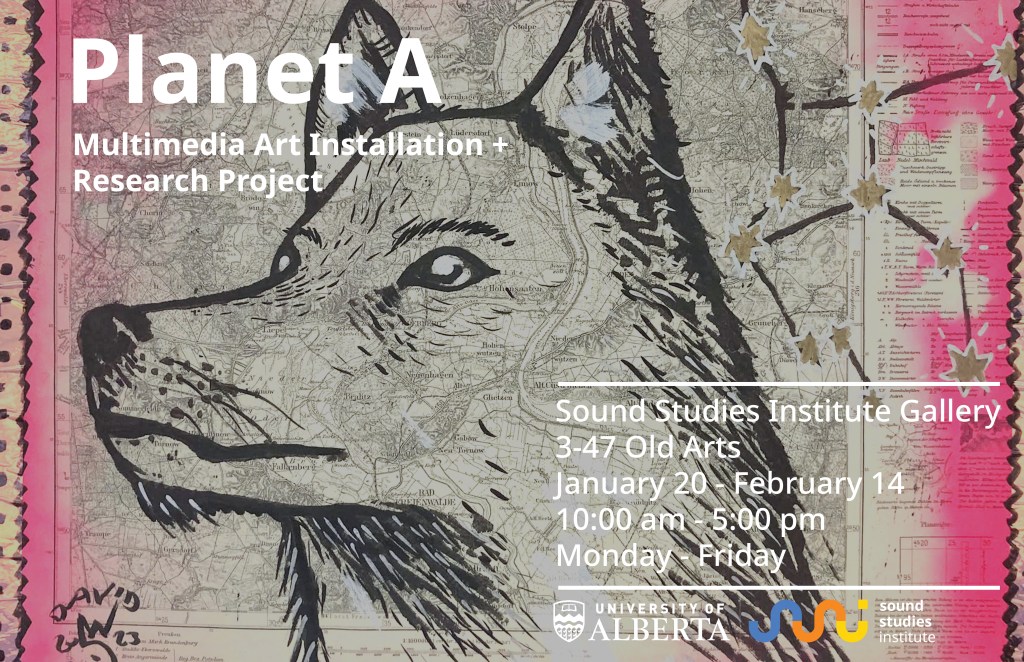
Planet A
Curated multimedia installation + research project
January 20 – February 14, 2025
SSI Audio Gallery, 3-47, Old Arts and Convocation Hall
10:00 am – 5:00 pm, Monday – Friday
Planet A is an art-based inquiry into emerging forms of life and practices in the Anthropocene – an idea following which the anthropogenic (manmade) activities are understood to have become a sufficiently strong force to give rise to a new geological epoch: the Anthropocene.
The authors of this exhibition have embarked on a critical, creative, and imaginative journey to prompt the spectators to engage critically and thoughtfully with conflict situations that arise from clashing environmental policy plans and reforms. An illustrative example is the ‘Rewilding Europe’ initiative to promote biodiversity, where European Union legislators are reviewing the legal status of protected apex predators, including the bear and wolf, and further afield, the lion and tiger.
How do we get out of such conflict? Where do we stand? Where do we draw a line? Which line?
Science: WeAreOne, an interdisciplinary research group lead by Prof. Dr. Antje Risius, invites visitors to take actively take part in the research program of the same name, which is funded by the German Ministry of Education and Research (No. 01EA2209), on animal-human-nature interactions in the Anthropocene. The term Anthropocene, proposed by Paul Crutzen and Eugene Stoermer in 2000, refers to the current geological epoch, which began around 1800 CE, and reflects the fact that many geologically significant processes and conditions have been profoundly affected by human activities. The questions posed to visitors to the traveling exhibition serve to find out which words and terms come to mind when they think of the Anthropocene and how to find a better balance, between human-animal-nature interface.
Sound: Dominik Eulberg, who comes from the Westerwald region in Germany, has been musically active worldwide for over 30 years. His discography now includes more than a hundred releases. He has received numerous awards for his musical work, including the German Record Critics’ Prize, has been voted Music Producer of the Year by trade magazines, and regularly occupies top positions in the DJ category.
Eulberg is a colorful jack-of-all-trades. His studies were in ecology, because awareness of nature and the protection of our native biodiversity have been close to his heart since childhood. He is committed to raising awareness of the beauty and worthiness of protecting nature in a variety of ways. He is an author with Eichborn-Verlag, where his nature book “Mikroorgasmen Überall” (Micro-orgasms Everywhere) was published, which won the “Wissensbuch des Jahres” (Knowledge Book of the Year) literary prize.
He develops nature-sensitizing games such as the multimedia bird quartet “Fliegende Edelsteine” (Flying Gems), is an ambassador for many nature conservation organizations, a guest scientist at the Museum of Natural History in Berlin, and is a regular guest on television programs, for example, his show “Eulbergs Kosmos” on SWR . Every two weeks, he publishes his column “Eulberg’s Tönende Tierwelt” (Eulberg’s Sounding Wildlife) in “Spektrum der Wissenschaft” (Spectrum of Science). He works continuously with the renowned nature filmmaker Jan Haft on TV and cinema films.
Eulberg’s commitment to public nature education was recently honored with a nomination for the German Environmental Media Award. His penultimate album, “Mannigfaltig”, which was thematically about biodiversity, made it into the official German charts, and his last album, “Avichrom”, made it into the top 40.
The wasp species Ceraphron eulbergi was named in his honor.
Art: David Weiss studied Sustainable Agriculture and Visual Communication (Illustration and Comics) under Hendrik Dorgathen. In addition to working as a freelance artist, David Weiss operates transdisciplinarily at the intersection of natural sciences, visual communication, and contemporary art. Through artistic and scientific research expeditions to Mongolia, Madagascar, and Burkina Faso, he explored how sustainable and climate-adapted land use, incorporating traditional local knowledge, can be communicated to communities with limited access to formal education through the medium of comics. Currently pursuing a PhD in Agricultural Marketing at the University of Göttingen, David Weiss continues to investigate how comics and contemporary art can make complex scientific concepts more accessible.
As a freelance artist, he paints on unconventional materials such as old cardboard, vintage maps, and discarded paintings—turning trash into treasure, embodying the motto: “Ideas, not waste.” Installations are created from leftover wool and scrap metal, while bronze casts are made from recycled copper and tin. Collages are assembled from found newspapers and overprinted with woodcuts and screen prints.
David Weiss’s works have been exhibited in numerous galleries and museums both domestically and internationally and are also represented in private collections. He has participated in various artist residencies and received multiple scholarships that have significantly contributed to his artistic growth. His publications include comic short stories and the graphic novel Mustafa and the Bumbos, which was nominated for the Independent Comic Prize.
Weiss’s overarching goal is to contribute to the preservation of our beautiful planet Earth through the synergy of science and art—the ultimate combination.
 Sound Studies Institute