
Upcoming Events and Exhibitions
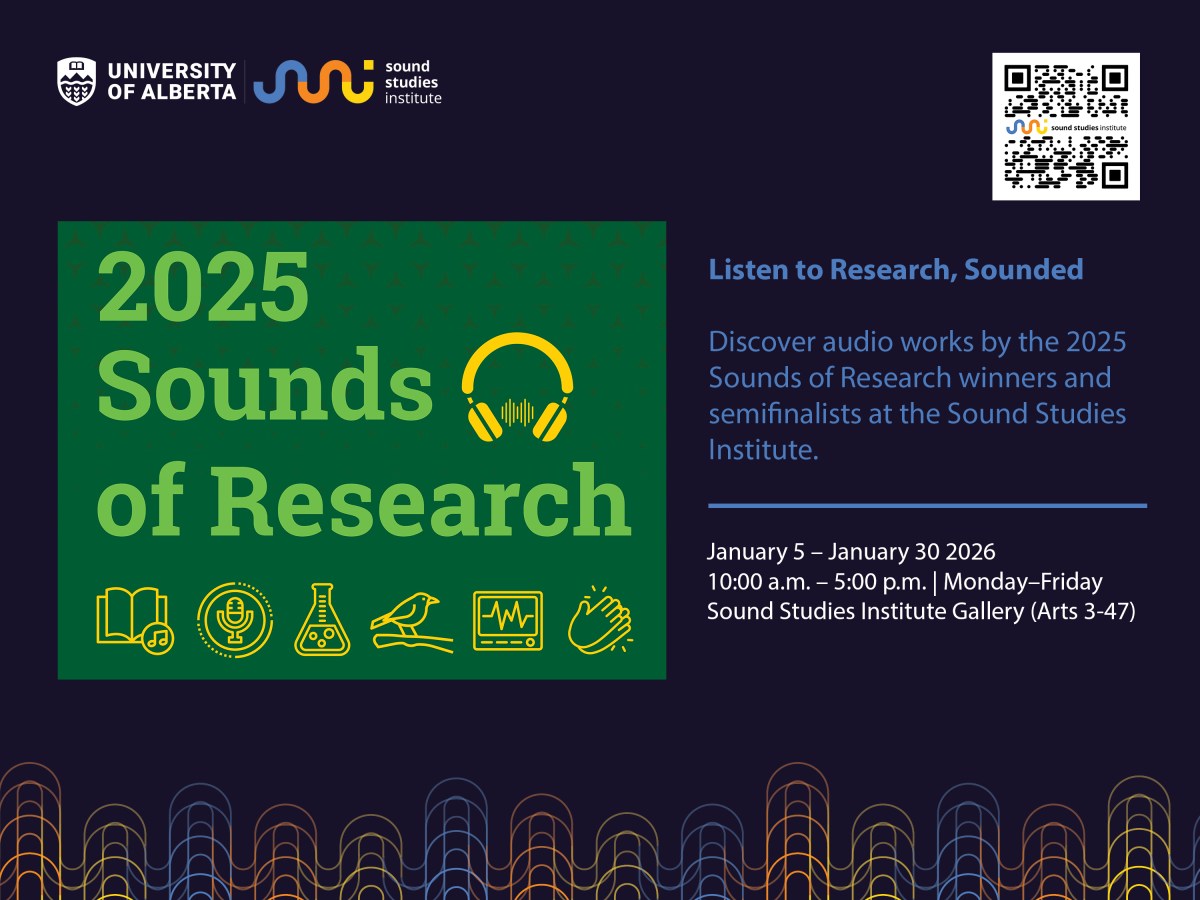
Sounds of Research Exhibition
January 5 – January 30 2026
10:00 – 5:00 Mon – Fri
Sounds of Research Exhibition
Keep readingSounds of Research Exhibition
January 5 – January 30 2026
10:00 – 5:00 Mon – Fri
Sounds of Research Exhibition
Keep readingThe Sound Studies Institute (SSI) at the University of Alberta supports research and creative activities that centralize sound in any way. SSI offers researchers opportunities to work collaboratively, discover new areas of convergent enquiry, and benefit from collective administrative support. SSI is home to a variety of research projects and affiliates, with projects that span numerous areas of inquiry, from bioacoustics and linguistics, to audio culture and the sonics arts, to name a few. We provide a locus for sharing, exploring, and celebrating collaboration and innovation across disciplines.
SSI’s offices and studios are located on the North Campus of University of Alberta, in room 3-47 in Arts and Convocation Hall (Old Arts). Our space include meeting and presentation spaces, digitization labs, recording and editing studios, a multichannel sound art gallery and a variety of archival collections. Click here for a map to find us.
The SSI offices are always open from 10:00 am – 5:00 pm on Wednesdays during Fall and Winter term, and 10:00am-5:00pm Monday-Friday when there is an Exhibition in the Sound Art Gallery. On other days of the week, we may be in and out of the office as we work on various research projects. If our door is open, come in and say hi!
If you would like to schedule a meeting with us, or have any other inquiries, please contact us at sounds@ualberta.ca
SSI’s home is near the south bank of the North Saskatchewan River in the heart of Edmonton, Alberta, which is on Treaty Six territory. Treaty Six is the framework that establishes the terms for sharing this place now, the agreement that locates both traditional and new cultural practices here. We are grateful also to be in the traditional territory of the Papaschase Cree First Nation, where Métis and other First Nations have sojourned and found welcome.
The cultural roots of these communities are deep, growing over thousands of years as successive newcomers to this area shared their cultural traditions. This location has particular resonance for sound studies researchers as they seek to create new forms of sonic expression and explore innovative approaches to historical and contemporary sonic environments.
 Sound Studies Institute