
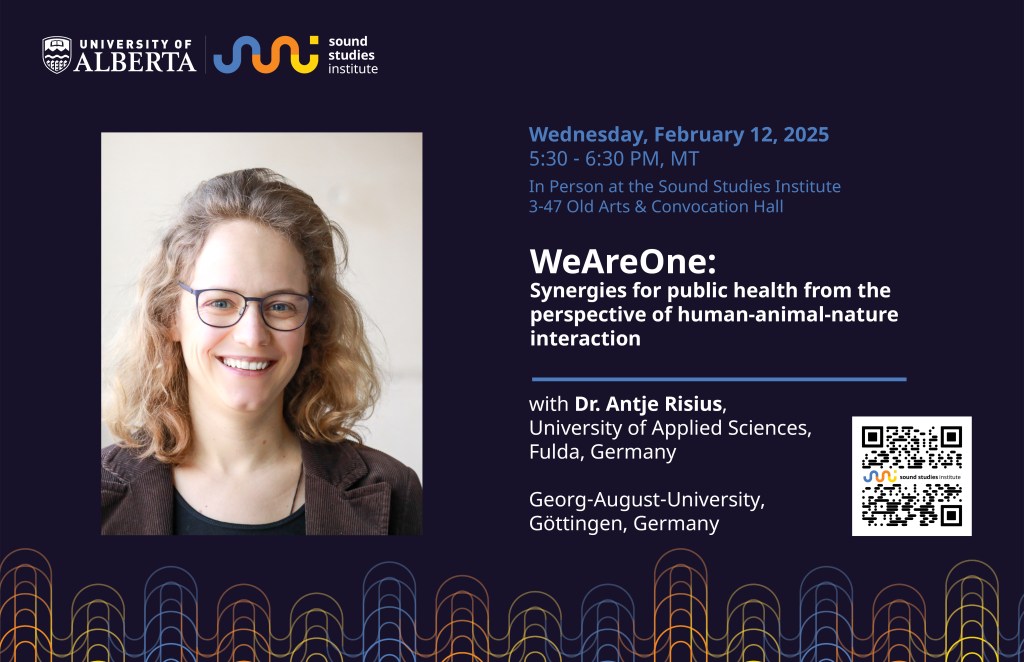
WeAreOne: Synergies for public health from the perspective of human-animal-nature interaction
with Dr. Antje Risius, Associate Professor at the University of Applied Sciences in Fulda
Wednesday, February 12, 2025
5:30 – 6:30pm
Sound Studies Institute
3-47, Old Arts Building
Add to Calendar
Visiting scholar Dr. Antje Risius will discuss the work of the WeAreOne research group in investigating new methodologies for communicating complex and sometimes contested scientific ideas with the public. How can collaborations between artists and scientists create more accessible venues for people to think and feel through some of the most pressing issues of our time?
The multimedia art installation Planet A by the WeAreOne research group is currently exhibited in the Sound Studies Institute Sound Art Gallery space. Read more here: https://soundstudies.ca/2025/01/24/planet-a/
Human-made climate change is causing environmental changes such as global warming and air contamination, which threaten human health just as much as that of animals and plants. A sustainable way of life would produce many positive synergies for humans, animals and nature. However, a consistently sustainable way of life often still encounters many doubts in our societies. Based on knowledge about the preservation of the common goods of climate, environment and health, the WeAreOne research group examines socio-cultural perspectives and analyzes established institutions and legal frameworks for greater sustainability.
Dr. Antje Risius is Associate Professor at the University of Applied Sciences in Fulda (Prof. in Sustainable Nutrition and Distribution) and leads the WeAreOne Research group at the University of Göttingen. She works in the fields of agricultural sciences, health and anthropology with various inter- and transdisciplinary applications and leads several projects in regard to food system transformation, planetary and public health. Her research interests include consumer food choice, nutrition and public health, behavior change communication (‘boosting’), sustainable food systems, experimental economics and institutional economics.
 Sound Studies Institute